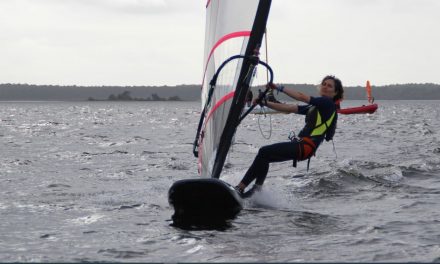
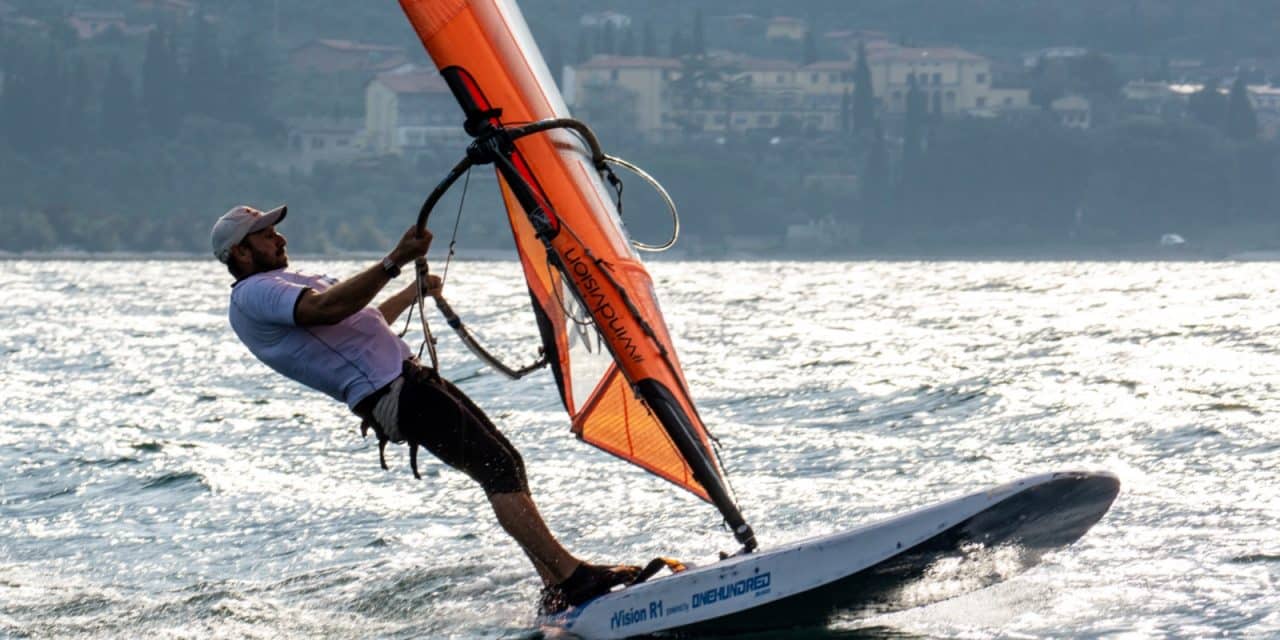
Interview passionné avec Radovan (Rado) Kubin qui a enregistré l’année dernière un nouveau flotteur Raceboard au World Sailing, la rVision R1 (https://www.rvision.fi/). Présentation et questions à Rado sur sa production spécifique en marge des grands fabricants qui a abouti à un titre mondial en 2022. Il confirme ainsi que sa planch est bien née et sera celle à battre en 2023.
FRA : Tout d’abord, félicitations Rado pour ton engagement effectif pour le développement de la Raceboard !. Peux-tu te présenter ?
Rado : Je suis originaire de Slovaquie (né en Tchécoslovaquie pour être précis) mais j’ai déménagé en Finlande il y a 21 ans. J’ai commencé la planche à voile à l’âge de 13 ans et je fais de la compétition depuis 1987. Nous avons dû construire nos propres planches à l’époque puisque les longues planches (DII, DI) n’étaient pas disponibles ou tout simplement trop difficiles à obtenir. Je me souviens avoir construit ma première Raceboard en prenant des mesures sur des photos dans un magazine au début des années 90. Heureusement, j’ai utilisé cette planche seulement une saison ou deux et puis j’ai eu mes premières vraies raceboard de AHD, F2 et Fanatic avant que la nouvelle génération de Raceboard ne surgisse.
Mon lien avec la fabrication / l’ingénierie ? j’ai une maîtrise en technologie de l’information et j’ai travaillé dans cette industrie toute ma vie active. J’aime avoir des projets dans ma vie personnelle aussi, pas seulement au travail. Par conséquent, je suis toujours inspiré par les nouvelles technologies ou inventions.
J’aime les Raceboard produites en Europe et j’ai pensé qu’il était temps d’en faire une en utilisant tous les derniers matériaux et technologies (y compris la modélisation 3D) pour en produire une de haute qualité.

Quel est ton engagement officiel dans les instances en planche à voile et que défends-tu?
Je suis président de SPLL (Finnish Board Sailing Association). Nous œuvrons pour presque toutes les classes de planche à voile et kitesurf. La mission principale de l’association est de développer le sport en obtenant plus de personnes intéressées. Nous mettons également à jour et maintenons les règles de classe locale et le calendrier des événements (y compris les courses) .
Il y a beaucoup de sports intéressants que les gens, en particulier les jeunes générations, peuvent faire, c’est pourquoi nous entrons en compétition avec les autres sports quand nous essayons d’attirer plus de gens dans les sports de voile. Les classes de raceboard et de longboard en général ne sont pas aussi attrayantes que certaines autres classes plus récentes pour la jeune génération. SPLL doit s’assurer que nous ne dérivons pas de nos objectifs en ne faisant pas de promotion pour une classe en particulier, mais plutôt nous nous assurerons que les gens comprennent toutes les options disponibles, y compris l’équipement de freeride.
Peux-tu nous dire ce qu’est rVision R1 ? Une entreprise ? Une marque commerciale ? Où est-elle située et pourquoi ?
rVision Oy est ma propre entreprise que j’ai créé pour fournir des services informatiques à l’origine. L’entreprise est en Finlande dans la capitale. Quand j’ai pensé à commencer un projet lié à la Raceboard, évidemment il était plus facile de le commencer avec la même entreprise utilisant les mêmes ressources financières disponibles dont les services informatiques. La R1 est ma première raceboard et donc le nom de raceboard. R1 signifie Rado1 qui, avec un peu d’imagination, vient de Radovan (van prononcé en anglais « one »)
Peux-tu nous décrire ton équipe autour pour développer et produire?
C’est le sujet le plus intéressant pour moi. En 2017, quand j’ai décidé d’investir dans le développement des Raceboard, j’avais besoin de quelqu’un pour modéliser la vision que j’avais en tête. Mon père, qui utilise la modélisation 3D depuis toujours, m’a aidé à faire le modèle initial. J’ai essayé de développer et de construire la planche en Finlande, mais il me manquait une vraie entreprise qui avait de l’expérience dans la construction de planches à voile. Après avoir fait construire les 2 premiers prototypes en Finlande, j’étais presque sûr que ce serait la fin du projet. Heureusement, en essayant de trouver une entreprise qui commercialisait des rails de pied de mât en carbone pour les longues planches, j’ai trouvé la compagnie (Onehundredboardz), elle construisait aussi des planches sur mesure. C’est là que la collaboration entre rVision et Onehundredboardz a commencé et nous avons réussi à faire construire le prototype numéro 3 très rapidement à la fin de 2020. Peu de temps après le 4ème proto a été fait pour tester différentes ailes/wing mais aussi sans cette option..
Une fois le prototypage terminé, la R1 était prête à entrer en production et c’est là que mon bon ami, David Jones, a aidé. Il avait déjà contribué à la conception du logo R1 pour le premier prototype
Bref. L’équipe est composée de peu de personnes impliquées dans le développement et la construction de R1. La collaboration avec Onehundredboardz (Matic Meza étant la personne principale) a permis à R1 d’obtenir la meilleure technologie sur mesure et des pièces comme le rail de pied de mat en carbone. Je me suis concentré sur les designs visuels et de shape tandis que Matic se concentre sur la technologie pour construire.
Reconnaître et honorer la collaboration – le rVision R1 propulsé par Onehundredboardz – est clairement indiqué sur les côtés de la planche.
Quels étaient tes objectifs pour construire un modèle en marge des compagnies mondiales comme Unifiber et Starboard ? Comment ton business model peut faire face aux entreprises qui produisent selon des modèles bien rodés avec des fabricants mondiaux comme Cobra?
Le principal objectif est de construire en Europe en utilisant toute la technologie et le matériel disponible pour atteindre la qualité, la légèreté et des planches durables. Comme déjà mentionné, R1 est le résultat d’un projet fait sur mon temps libre. Je l’ai officiellement enregistré au World Sailing pour permettre à d’autres concurrents de l’utiliser dans les courses officielles.
Nous accordons beaucoup d’attention à tous les détails et à la qualité de construction. De nombreuses pièces sont découpées par des machines CNC commandées par ordinateur à partir de nos propres design ou fabriquées avec des moules très précis sous haute pression. Nos planches se composent d’autres pièces que nous fabriquons aussi.
La R1 est littéralement une vraie « machine de course » et en tant que telle ne peut pas être vraiment fabriquée de la même façon que celles produites par des sociétés mondiales. Nous pouvons par exemple personnaliser la position des footstraps en fonction des préférences et du style des riders.
… et comment peux-tu être concurrentiel par votre prix final de vente puisque vous incluez un temps important fait à la main pour construire un modèle de haute technologie avec une technologie en sandwich carbone. Tout le monde sait que ce temps est très impactant en Europe. Quel est votre prix final avec pieds de mat et dérive ?
Comme je ne suis pas dépendant d’un besoin de profit à faire sur la R1, je peux maintenir la production dans l’UE et contrôler les prix en vendant la planche en suivant le concept de vente directe au consommateur. Le prix actuel est de 3990 EUR hors TVA. La TVA est facturée dans l’UE pour les achats effectués par ses consommateurs. Nous verrons comment le prix devra évoluer en 2023 puisque chaque augmentation d’énergie ou de matières a un impact direct.
La dérive et le rail de pied de mat sont deux problèmes courants à surmonter pour produire seul une raceboard. Comment as-tu géré ces sujets stratégiques pour les obtenir fiables, performants et à un coût acceptable ?
Grâce à la collaboration avec de nombreuses pièces existantes produites par Onehundredboardz, comme le célèbre rail de pied de mât en carbone utilisé pour leus D2. Il était déjà disponible. Nous avons dû l’améliorer légèrement afin de tenir compte de contraintes liées aux vitesses plus élevées et aux vagues plus grosses dans lesquelles la R1 peut être utilisée par rapport à la DII Onehundredboardz. C’est exactement là où l’expérience que j’ai acquise en Raceboard a beaucoup aidé.
J’ai géré la dérive seulement en 2022 et, par conséquent, la planche a d’abord été livrée avec celle de la DII de Onehundredboardz. A présent, nous recommandons de l’utiliser avec la dérive Boss R1 de 85 cm de long. Cela a eu pour conséquence de devoir redéfinir la tête de dérive pour l’adapter à la R1.
Depuis le début de cette année, nous livrons la R1 avec une toute nouvelle dérive de 85 cm qui est très solide. La forme est très proche de la dérive Boss mais le profil hydrodynamique est légèrement différent.

Un deuxième point très important est le puits de dérive qui est une partie très technique à fabriquer pour rendre la planche durable et légère. Beaucoup de shapers venant du surf, du paddle ou du funboard qui ont voulu construire une raceboard avec son puits de dérive ont été confrontés à un sujet vraiment difficile. Ce puits de dérive peut devenir un vrai cauchemar pour le fabricant s’il n’est pas robuste.
Oui, le puits de dérive rend la fabrication complexe. Le puits doit être construit séparément avant de l’insérer dans la planche pour stratification. Une fois que tout est fait, les lèvres du puits de dérive peuvent être collées.
C’est aussi une autre partie où R1 diffère. C’est très précis; les dérives sont très légères et tout fonctionne sans problème.
Quel a été ton choix final en terme de technologie et pourquoi avez-vous choisi de shaper au lieu de viser une planche creuse qui devrait être plus légère (Le noyau en mousse pèse autour de 5 kg pour 300L). Le dernier fabricant qui a fait des raceboards creuses, pour autant que nous le sachions, était Lechner, avec une production semi-custom.
Désolé pour la correction, le dernier fabricant à l’avoir fait est mon ami Kale de Finlande qui vient de faire enregistrer sa planche avec World sailing.
Je n’ai jamais été un grand fan de planches entièrement creuses. 300 L de volume, et une prise d’eau élevée possible par défaut d’étanchéité . Je serais plus en faveur de remplir l’espace avec de la mousse expansée super légère. SI la planche creuse s’ouvre, elle peut se remplir d’eau très rapidement et l’histoire se transformer en exercice de sauvetage. Une telle production nécessite une certaine R&D et sûrement de plus grandes quantités de planches à fabriquer.
J’ai utilisé R1 dans un vent de 35 noeuds et une voile de slalom de 7,3 m2. La planche était plus en l’air que sur l’eau en passant une houle de 1,5 à 2 m à grande vitesse. La R1 a géré la situation parfaitement, aucun dommage, toutes les pièces ont fonctionné comme prévu. Si je m’étais écrasé et avait cassé la planche, j’aurais pu revenir puisque le stratifié sandwich ne permet pas à la planche de couler.
Est-il difficile de respecter pleinement une série de production identique par ta façon de faire puisque tous les modèles enregistrés à WS doivent être absolument identiques?
Respecter les tolérances permises n’est pas si difficile. Tout est conçu en 3D par CAO, découpé par ordinateur, stratifié dans des moules. Nous mesurons soigneusement toutes les planches et fournissons un certificat avec. Par conséquent, chaque client connaît le poids exact de la planche.
Ton shape est un succès puisque ta planche a remporté un double titre mondial l’année dernière avec Patrik Polak. Preuve de concept parfaite ! Quels étaient les détails précis sur lesquels tu as travaillé avec ton équipe pour atteindre une performance maximale au près et au portant ? La ligne de scoop? L’outline ? La conception des « batwing »? On rapporte que Patrik est particulièrement efficace pour maintenir le planing au portant.
Patrik, mon beau-frère et un très bon ami d’enfance, est tout simplement un concurrent très fort dans de nombreuses classes.
J’ai conçu la planche pour les concurrents plus paresseux et légèrement plus lourds comme moi. Par conséquent, la question était de savoir si Patrik ne serait pas ralenti par une planche avec un volume inférieur à la R1.
Quand j’ai envoyé la première vidéo du proto 4, il s’y est intéressé. Quand il a eu sa R1, je pense qu’il était encore un peu inquiet de savoir si cette planche pouvait vraiment lui faire atteindre le sommet, mais après quelques essais, il ne faisait qu’un avec la planche et était prêt pour gagner.
Les protos R1 et la R1 finale produite ont été conçues et testées dans les conditions exigeantes de la mer Baltique par moi principalement. Les vagues de la mer Baltique sont élevées et courtes. J’ai dü faire pas mal d’essais pour trouver le meilleur shape capable de faire face à de telles vagues au près et au portant et avec les meilleurs angles possibles.
Je ne veux pas trop donné les détails de la forme mais disons que sans les wing, la R1 ne serait pas la même.
Pour terminer cette longue entrevue, un problème majeur pour espérer un développement de la Raceboard est actuellement son accessibilité. Maintenant, les planches sont très faciles à utiliser, pas si techniques et performantes partout dans toutes les conditions de vent. C’est l’avantage définitif de la raceboard. Mais elle est maintenant relativement coûteuse et fragile en raison des hautes technologies choisies par tous les fabricants. Crois-tu qu’il soit possible de produire une raceboard européenne « bon marché » pour tous, comme le véliplanchiste, qui veut une dérive, une planche robuste avec un shape performant pour naviguer sur de longues distances, en flotte de club, … sans cibler la performance absolue ?
Tout dépend de la demande et de l’investissement initial. Malheureusement, les concurrents fidèles à la classe Raceboard sont limités. Ceux qui veulent vraiment être concurrentiels exigent des conseils d’administration de grande qualité, moi y compris.
S’il y avait une forte demande pour le développement et la construction de Raceboard européennes à prix abordable, il y aurait également un intérêt de la part d’investisseurs potentiels. En plus du soutien et du dévouement de toutes les grandes communautés européennes de planche à voile, les pays sont aussi nécessaires. Dans ces circonstances, il y aurait une volonté commune de le faire.
Je me concentre actuellement sur les courses de haute performance. Cela dit, je serais heureux d’aider à mettre au point une Raceboard abordable si on me posait une telle question.
Qu’aimerais-tu ajouter?
La grande question est toujours la suite.
Ensuite, je voudrais rendre plus de gens heureux en appréciant la bonne qualité de la R1. J’aimerais essayer d’autres technologies, et enfin il serait bien de proposer un modèle avec un volume un peu plus petit aussi.
Merci Rado pour ton engagement et félicitations pour cette belle réussite. Bon vent pour 2023 !