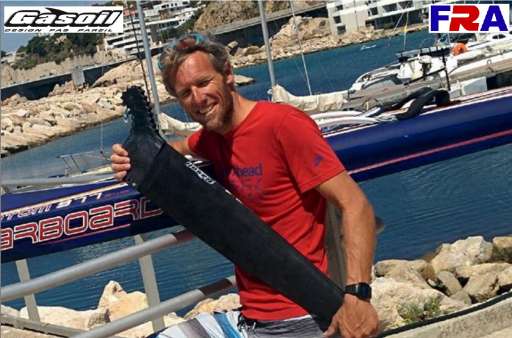
FRA – Depuis 2 ans, F.R.A. discute avec GASOIL Fins et Philippe CECCHI sur la faisabilité de produire des dérives spécifiques raceboard faites par un spécialiste des appendices. GASOIL Fins (ailerons-gasoil.com) n’est plus à présenter dans ce domaine avec des ailerons très prisés depuis des années et un record mondial de vitesse. De ces discussions, s’est concrétisée une première dérive sortie mi-juin qui a couru dans la foulée le championnat du monde avec Nicolas HUGUET et finit sur la second marche du podium pour un coup d’essai. L’opération a pu se faire grâce à FWODC (France Windsurfing One Design Class) et Jean-François REGGIO qui a soutenu financièrement F.R.A. pour cette première phase de développement à risque.
Nicolas HUGUET en discussion avec Philippe CECCHI pour valider une version de dérive finalisée après sa 2nde place aux championnats du monde 2017 à Salou (Espagne).
FRA – Philippe, tu n’es plus à présenter du côté du slalom et de la vitesse mais te voir t’intéresser à une dérive qui ne fonctionne qu’à basse vitesse et qu’aux allures de près serré, un peu loin des limites habituelles qui te préoccupent, qu’est-ce qui t’a motivé pour adhérer à ce projet?
CP – J’ai toujours aimé faire des équipes de travail constituées de gens passionnés, des personnes qui se laissent guider par leurs rêves. Il en ressort généralement de belles définitions au service des utilisateurs.
FRA – As-tu déjà eu des expériences passées sur des profils de dérive?
CP – Oui j’ai il y a quelques années j’ai été invité dans le développement et la réalisation d’une dérive et safran pour un championnat du monde de FIREBALL. Et aussi plusieurs expériences dans le cadre de réparations sur des habitables monocoques et multicoques.
FRA – F.R.A. t’a fait confiance lorsque tu as parlé d’une dérive innovante avec une épaisseur réduite alors que tous les habitués ne jurent que de profils épais et puissants pour naviguer dans le petit temps, très fréquent. Pourquoi cette vision différente dès le départ?
CP – En observant le modèle de dérive que Fred BECQUART m’a présenté comme étant une dérive de série, j’ai eu comme l’impression que le temps c’était arrêté dans les années 80 et que toutes les valeurs semblent être calquées sur des théories venant du bateau.
Une planche de Windsurf navigue au planning ce qui est rarement le cas pour un monocoque.
Je me suis donc dit qu’il pouvait être intéressant avec tous les risques que ça comporte, de s’orienter vers le coté glisse du programme.
FRA –Tout repose sur l’épaisseur?
CP – Non tout ne repose pas sur l’épaisseur bien sûr. Par rapport aux années 80 nous disposons de bien plus de moyens techniques.
Aujourd’hui, l’utilisation de la fibre de carbone est bien plus répandue, cela nous permet de réduire les épaisseurs tout en obtenant de meilleures propriétés mécaniques et plus spécifiques. L’utilisation d’outils numériques CAO nous a permis de créer un modèle 3D avec un outline complètement revu, de positionner des options différentes dans la longueur du profil, de redessiner les courbes du bord d’attaque et de parfaitement contrôler les épaisseurs du bord de chute.
La réalisation d’un moule FAO et une fabrication full carbone injectée nous permet de produire une dérive dotée d’une géométrie de précision et de propriétés mécaniques exceptionnelles.
FRA – Nicolas HUGUET a immédiatement validé ce premier prototype de développement au-dessus de 12-15 nœuds … et a confirmé qu’elle était également dans le coup dans le petit temps. Des échanges avec Nicolas devraient permettre d’aller plus loin pour une version V2 finale.
CP – Nicolas HUGUET est revenu avec quelques finesses et micro réglages qui devraient apporter plus de précision dans la définition des programmes de navigation. Ces modifications sont à l’étude pour un nouveau moule de la version V2.
Encore un grand bravo à Nicolas HUGUET qui est revenu avec un titre de vice-champion du monde, cela dans du petit temps alors que nous pensions que c’était la partie du programme de la dérive suscitant le plus de questions. Avec un peu plus de vent lors de cette régate, nous aurions pu espérer plus encore…
FRA – Il faut également dire que tout s’est enclenché et concrétisé en moins d’un mois (juin). Un mois pour dessiner, faire un moule, fabriquer un premier modèle très bien fini et le valider sur l’eau…. Un miracle ou une explication rationnelle? Tout seul sur ce travail?
CP – Oui c’est ce que j’explique au début, la magie de faire des équipes de passionnés a opéré …
Note : parce qu’il faut le citer le petit Nicolas GOYARD, un champion de windsurf mais aussi, je peux vous assurer qu’avec un soft de 3D, il est plutôt adroit. Il nous a donné un gros coup de main pour le dessin et l’usinage des moules.
FRA – A quand une version de cette nouvelle dérive dans ton catalogue? Adaptable à toute planche?
CP – Je pense que cette option est techniquement réalisable nous en avons pour le moment juste parlé. Si un certain nombre de demandeurs se manifestent, peut-être qu’il faudra passer à l’action.
(Note: depuis cet interview fait début aout 2017, la décision a été prise d’inclure un système permettant d’adapter la dérive à toute planche selon sa forme de tête. Cette option qui amène de la polyvalence retarde un peu la finalisation du projet par des contraintes supplémentaires. La version finale sera disponible à partir de fin septembre ou courant octobre)
FRA – L’ultime ‘étape de ce projet dérive sera pour FRA, sa production en série à prix plancher. Sera-t-il possible selon toi d’adapter un profil haute-performance carbone à une production série en verre. Jouable du côté des procédés et des matériaux?
CP – Le produit que nous avons réalisé est défini pour la compétition et sans compromis, je pense pouvoir le proposer aux environs de 700€. Certes cela peut représenter beaucoup d’argent pour certain, j’en suis conscient. Mais l’emploi de matériaux les plus Hi-Tech et l’incidence de la main d’œuvre dans une production artisanale nous conduise inexorablement à ce prix. L’idée d’un produit moins cher est séduisante On pourrait par exemple remplacer les fibres de carbone par des fibres de verre, utiliser une résine moins chère. Oui possible en sachant que les valeurs mécaniques de la pièce pourraient en prendre un sacré coup. Et malgré tout, le coût de la main d’œuvre reste le même quelle que soit la matière …. Délocaliser ? Donc, proposer un produit un peu moins cher et beaucoup moins bon me fait moyennement vibrer … Dans l’immédiat bien que j’y réfléchisse, je n’ai pas de solution concrète à proposer.
(Note: F.R.A. qui est attentif à la forte évolution des procédés actuels pour mettre en œuvre plastiques et composites, pense à de réelles opportunités d’évolutions de produire plus économiquement sans perdre de manière rédhibitoire en propriétés mécaniques … affaire à suivre).
FRA – merci Philippe pour toutes ces précisions et ton implication.