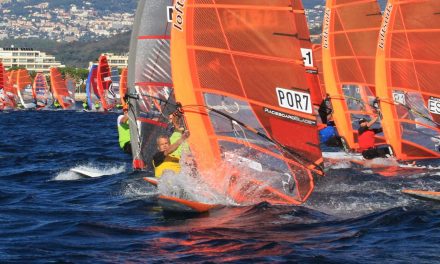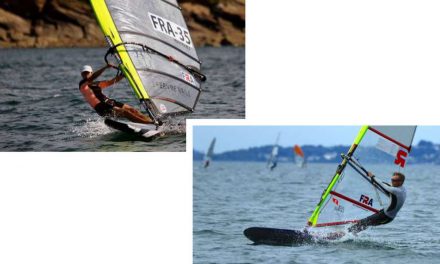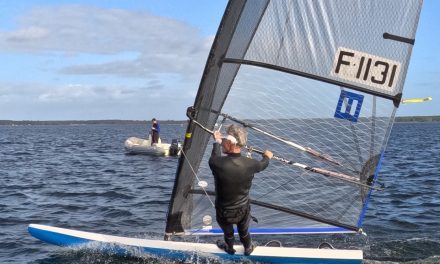

L’attribution de l’organisation des Jeux olympiques 2024 à Paris, mettent en avant notre nation et nos athlètes sur toute la planète depuis sept ans. Nous y sommes au présent ! Le titre olympique en windsurfing se défend pour la première fois au-dessus de l’eau par l’avènement du foil. Starboard est le fabricant qui a proposé l’iQFoil aux hommes et femmes. En coulisse de ce leader mondial, Rémi Vila a grandement porté et défendu ce projet. Originaire de Martinique et exilé en Thaïlande pour développer les gammes Starboard, Marseille fait partie de son histoire puisqu’il y a remporté le championnat de France 1991 en Raceboard Lourds devant 75 coureurs surmotivés. Hasard de la vie, il a été de retour sur le même site en 2024 pour veiller techniquement sur le matériel des coureurs olympiques.
L’occasion est donc idéale pour mettre en avant, Rémi, un des grands contributeurs au windsurfing de ces trente dernières années.
- Rémi, … globe trotter ?
Globe trotter, oui ! je voyage pour le windsurf depuis l’âge de 15 ans. J’ai parcouru le monde entier, d’abord pour faire des championnats internationaux en tant que coureur jusqu’à ce que je rencontre Svein Rasmussen en 2000 et commence à travailler pour Starboard. Je me suis installé définitivement en Thaïlande en 2008 et je continue à beaucoup voyager professionnellement à bientôt 56 ans. 😊. Le Japon, la Thaîlande, Penghu (Taiwan) ou le vent est terrifiant et les Gorges (USA) m’ont le plus marqués, avec bien entendu la Martinique et la baie de Fort de France, ma terre natale.

- Comment as-tu commencé le windsurf tout jeune ?
J’ai commencé la voile CN Schoelcher à l’âge de 5 ans en Optimist, en famille, puis la planche à 10 ans. J’ai pratiqué les deux supports avant de basculer définitivement sur le windsurf à 12 ans. Je suis toujours licencié au CN Schoelcher. Au club, nous naviguions beaucoup, simplement entre copains, même entre midi et deux lorsque nous avions école jusqu’à ce que je sois dans un collège où j’avais tous les après-midis libres pour naviguer en semaine et toute la journée le week end.
- On t’a découvert en métropole en 1991 par un titre de champion de France Raceboard gagné en Lourds à Marseille parmi d’autres prétendants très affutés. On se rappelle Rémi avec casquette et lunettes opaques en mode fermé sur l’eau pour gagner et plus ouvert à terre. Tu gardes quel souvenir de ce premier championnat et que t’a-t-il ouvert pour la suite, à titre personnel ?
J’y suis allé en ayant fini mon service militaire dans la marine en Martinique, trois mois plus tôt. J’ai pu m’entrainer tous les jours pour me préparer à ce premier championnat de France qui a été une révélation, un déclic pour moi. J’ai gagné un mois avant le championnat nord-américain. Jusque-là, j’étais condamné pour l’olympisme en planche Lechner car j’étais trop lourd pour performer. Le pumping était également interdit. La Raceboard m’a permis de m’exprimer pleinement sur un support adapté pour moi, plus puissant, avec des résultats.
Oui, comme tu le précises, j’étais effectivement très fermé avant les régates, dans ma bulle avec du reggae dans mon walkman, concentré, à vérifier mon matériel 10000 fois. Par contre, de retour à terre, tout s’ouvrait et je redevenais très abordable.
C’est incroyable que tout ait commencé à Marseille pour moi en 1991 et d’y être cette année pour les jeux olympiques. La boucle est bouclée ! Déclic en 1991 et les JO en 2024.


- Quelles ont été tes plus grosses perfs par la suite et sur quels supports ?
En Raceboard principalement, j’ai été vice-champion d’Europe et deux fois champion du Monde, en Orégon (USA) et à Puck (Pologne) en 93/95. Je m’entrainais beaucoup pour être vraiment affuté. Je suis ensuite passé en formule 42 (courses en Raceboard et slalom) où j’ai raté le titre mondial au Japon, également en Raceboard, à cause d’une casse matérielle. J’ai fini double vice-champion du monde sur ces deux supports !
Je suis ensuite passé en Formula où je garde un souvenir mémorable du championnat de France à Brest où je me suis battu avec Antoine Albeau, dans des manches d’anthologie, dans 40/45 nœuds avec des vagues de face. J’étais le seul à pouvoir tenir Antoine jusque l’arrivée.
Par la suite, j’ai baissé en intensité pour raison professionnelle et j’ai poursuivi en Formula Expérience où j’ai été champion du monde Master en 2008 et 2011.


- Des coureurs ou concepteurs t’ont-ils marqués ou inspirés à l’époque ?
Celui qui m’a toujours inspiré est Peter Thommen. J’ai adoré son premier contact qu’il ne doit plus avoir en mémoire, cela fait très longtemps. J’ai été impressionné par ce qu’il a fait avec Bjorn Dunkerbeck. Je le rencontre encore régulièrement. J’apprécie vraiment sa mentalité et sa façon de penser. C’est un très grand shaper avec un énorme feedback personnel.
- A quel moment s’est fait la bascule de coureur de niveau international à celui de concepteur pour une marque devenue leader ?
Le déclic s’est fait en 2000 quand j’ai rencontré Svein Rasmussen en Thaïlande lors d’un championnat à Pattaya. Il m’a proposé de rester avec lui pour profiter de mes analyses et de ma force de proposition pour améliorer les shapes. Une preuve de concept l’a convaincu où des modifications que je lui avais proposées ont fonctionné. J’ai commencé par venir trois à quatre fois par an en Thaïlande pour développer des planches. Après un gros problème de santé résolu en 2007, il m’a proposé de venir à plein temps.
Mais la première planche que j’ai shapée avec Guy de Chavigny, c’était en 1987,une planche de slalom. L’année suivante, j’ai fait une division 2 toujours avec Guy à partir d’un moule d’une Davidson, creuse pour la carène et pleine pour le pont.
- Comment se passe une semaine type de Rémi Vila en Thaïlande ? On te voit aussi souvent dans les aéroports, par les réseaux sociaux ? Tu fais combien de « milles » par an ? …pour aller où et y faire quoi ?
Je travaille minimum 54h par semaine mais j’adore ça. J’ai beaucoup voyagé pour développer des planches, rencontrer les coureurs. Tout le début de ma carrière, j’ai cherché à emmagasiner un maximum de données pour avoir les bons automatismes et trouver des solutions rapidement. Cette base me permet d’être efficace pour développer un modèle. Je fais rarement trois protos pour obtenir le bon. Je voyage à présent moins. De 10 voyages au début, je n’en fais pas plus de quatre à présent.
Je passe du temps aussi sur les réseaux sociaux pour partager ma passion avec toujours un côté positif. Communiquer que la vie est belle est important pour moi


- Pour revenir au gros sujet du moment : Rémi et l’olympisme ? Chapitre nouveau de ta vie avec l’apparition récente de l’IQFOIL ou longue histoire personnelle et professionnelle ?
Je n’ai jamais eu le gabarit pour les supports olympiques, donc sans possibilité de pouvoir m’exprimer en tant que coureur. Cela m’a frustré, vraiment ! Un vrai regret. Par contre, je me suis dit que lorsque j’aurais l’opportunité de faire une planche olympique, je ne raterais pas l’occasion.
Mon mentor, Jean-Pierre Deltato, avait participé au développement de la Windglider olympique et à 13 ans, je lui avais dit, sur le ton d’une plaisanterie que je ferai une planche olympique. Finalement je l’ai faite mais cela a été une longue histoire, dommage qu’il ne l’ait pas vue car décédé en pêche sous-marine il y a bien longtemps. Avec Svein Rasmussen et Tiesda You, nous avons fait une première planche en 2003. Nous avions proposé la Z class, une espèce de formula d’un mètre de large avec un nez pointu, une étrave. Notre planche avait été classée seconde derrière la Mistral Prodigy où finalement la RS :X a été retenue ! On est revenu proposer en 2008 une planche proche de la RS :X évoluée avec notamment des batwing. Finalement la RS :X a été reconduite directement mais tout le développement a resservi pour lancer la phantom 377 avec beaucoup de succès jusqu’à aujourd’hui. On est revenu présenter une formula et là, gros échec par son manque de polyvalence en dessous de 8 nœuds, face à la RS :X. 0 pointé des 19 votants ! La quatrième tentative a été la bonne en 2019 au Lac de Garde avec l’IQFoil, choisi unanimement par les 20 coureurs testeurs choisis par le World Sailing.


- Proposer du foil comme support olympique, cela suppose une technologie aboutie alors que paradoxalement, ce support volant est très récent. Qu’est-ce qui a rendu possible cette proposition sans risque de partir à la faute côté fiabilité et stricte monotypie. Votre expérience était limitée sur ce support. On imagine que le droit à l’erreur n’existe pas dans ce cadre.
Grâce à Tiesda You qui a créé sa structure pour développer du foil. Par lui, on a pu présenter un support foil au World Sailing. Comme c’était nouveau, il fallait de la fiabilité et nous l’avons eu. Côté gréement, Severne a su s’adapter pour en proposer en 8 et 9m²,peaufiné par Gonzalo Costa Hoevel. Pour réduire l’engagement physique dans le futur, les surfaces devraient passer prochainement à 8 et 7.3m² pour les hommes et femmes, sans rogner sur la capacité à voler tôt.
- Quelle a été ta mission sur site, la semaine des JO ?
Ma mission a démarré avec la remise du matériel aux sélectionnés le 20 juillet par tirage au sort. J’ai aussi assisté le World Sailing en tant que technicien pour les réclamations sur des questions techniques. J’étais aussi le référent pour Starboard, accompagné de Gonzalo pour la classe
- Les JO vus en spectateur privilégié de l’intérieur, que ressens-tu de particulier comparé à un championnat du Monde que tu as vécu de multiples fois ?
Cela a été une espèce de révélation. La tension, la pression et le niveau sont au maximum et c’est très palpable. Les riders les plus posés qui ont su gérer le stress se sont retrouvés en haut du classement. Ce n’était pas forcément les plus performants qui pouvaient gagner mais davantage celui ou celle sachant gérer l’événement par le contrôle de soi. On a eu l’exemple de Nicolas Goyard qui s’est exprimé depuis. Il a dit clairement ne pas être préparé mentalement. Très rigoureux, très analytique et très appliqué dans sa façon de faire, il a craqué face à la gestion étonnante du comité de course sur certains points. Pourtant il avait plus que le talent pour faire un résultat fantastique. Aux JO, le facteur mental est de loin le plus important.


- Les JO sont présentés par les médias avec beaucoup d’euphorie. Quelle est l’ambiance en pleine épreuve ? D’autant plus que le vent s’est fait attendre sous un soleil de plomb.
J’ai été très déçu de la retransmission manifestement attribuée à Eurosport, une chaîne payante. C’est à mon sens inadmissible que les spectateurs ne puissent pas avoir accès aux retransmissions gratuitement. Le choix a été fait par Paris 2024 de donner tous les droits à une seule chaîne. La couverture médiatique de la planche à voile était en deçà de ce que cela aurait dû être. Au même moment, la PWA rediffusait en direct gratuitement les slaloms X de Fuerteventura !
Côté ambiance, malgré ce soleil de plomb titanesque, c’était génial d’entendre les supporters hurler depuis la terre aux passages de bouées. Je n’avais jamais vu cela même sur un championnat du monde, sauf peut-être une fois au Japon qui est très fort sur les organisations avec un réellement engouement du public.
- Côté matériel, comment as-tu géré avec Starboard le support technique aux coureurs sur ces JO ? Combien de stock avais-tu prévu .. au cas où ?
J’étais en soutien technique sur l’eau avec Gonzalo et Valérie. Si un(e) concurrent(e) cassait sur l’eau sans pouvoir rentrer à terre, on pouvait lui changer sur place n’importe quel besoin pour lui éviter de rater la manche suivante. On a pu réparer, remplacer poncer sur le champ. Ce service a très apprécié et a sauvé les JO de plusieurs coureurs.
Pour 48 compétiteurs, on avait 5 planches et foils en plus, 6 voiles et mats dans les deux tailles. On avait tout le matériel sur le bateau avec une seule planche par souci d’espace.

- Et l’après JO, comment te projettes-tu professionnellement pour la suite ? … revenir à la routine habituelle.
On pense déjà à 2032. En 2026 ou 27, il y a aura possiblement une nouvelle évaluation du World Sailing et nous allons travailler sur la proposition de nouveaux foils et voiles pour l’après Los Angeles 2028 pour que les coureurs en IQ Foil restent performants sur des championnats du monde open avec du matériel libre.
On a aussi relevé les petites améliorations à faire pour L.A. 2028.
- Quels sont les axes de développement prioritaires pour toi ou les plus prometteurs pour le futur ? Tous supports confondus.
Starboard a dans son catalogue, tous types de planches pour toutes les disciplines. On répondra toujours au maximum pour tous. Là, il y aura le plus d’engouement, on mettra davantage de moyens pour rester au top. Actuellement, les forces sont placées sur les isonic et les X-15.
- Côté Raceboard, Severne ne propose plus de voile depuis plusieurs années. Un retour est-il possible ?
Je travaille sporadiquement pour Severne mais c’est vrai que cela fait un moment que l’on n’a pas travaillé pour ce programme. On pourrait engager un nouveau développement pour la gamme 2027, 2026 étant déjà quasi bouclé.
- Le gréement iQFOil serait-il performant sur une Raceboard, selon toi ? Une déclinaison à faire ?
Oui, les voiles d’iQFoil sont faites pour la Raceboard à partir de 15 nœuds. Elles sont très très stables et très performantes. Tu peux les tenir très loin en restant très légères comparativement à une voile de RS : X, par exemple. Par contre dans le vent léger, elles sont trop raides pour être choisies. La voile que l’on a mis en photo sur notre catalogue avec la Phantom est justement une iQFoil. Je me suis vraiment régalé avec.
- Pour finir, pas trop compliqué de gérer ton engagement permanent pour le windsurf et vie de famille ? Bientôt « Rémi Junior » sur les traces de son papa et sur quel support ?
J’ai la chance d’avoir une famille conciliante et j’ai un fils qui a 11 ans. Il commence à s’intéresser à la planche à voile. Il se cherche encore entre la planche et d’autres sports. Il a commencé la planche à 5 ans en aileron. Il a su planer dans les straps sans harnais puis fait à présent la même chose en foil. Le jour où il a réussi à naviguer au harnais, il n’a plus voulu faire d’aileron, trouvant le foil plus fun. Je le comprends car j’apprécie le foil mais j’apprécie aussi la Raceboard pour faire des balades avec des sensations phénoménales sur la tranche. Cela me remémore aussi mon passé en championnats. … mais mon fils a choisi le foil.

- Quelle est ta ou tes devises ?
Je dirais en avoir deux : « never give up ». Tu ne dois jamais abandonner quoi que tu fasses.
Tu commences quelque chose, tu vas au bout. Cela s’apprend bien en régate. Tu commences une régate, tu n’abandonnes pas. Tu casses un bout de harnais, tu finis sans harnais. Jamais, tu n’abandonnes.
Ma seconde devise : « ce qui ne tue pas, rend plus fort ». J’en ai vu des couleurs de côté-là ! j’ai déjà dû passer neuf vies déjà et je suis toujours là, j’espère encore pour longtemps.
- Un message particulier à passer à tous?
Je dirais, scolairement, cela ne s’est pas très bien passé pour moi. Je n’ai même pas mon bac. Je pense que l’on a voulu m’imposer un système qui ne me convenait pas. J’avais des compétences ailleurs mais on voulait me pousser là où cela ne me convenait pas. Le système généraliste a du bon, c’est certain mais quand c’est trop généraliste, j’ai l’impression de tourner en rond en me demandant à quoi cela va servir. Quand tu es quelqu’un de plus technique, matheux ou plus littéraire et que tu veux te spécialiser, le système est trop général. A l’inverse le système américain est trop spécialisé manquant de généralisme. Je ne sais pas où est le bon système mais en tout cas, je l’ai mal vécu en tant qu’ado. J’ai trouvé ma voie dans le sport finalement. C’est ce que je voulais faire et je l’ai fait sans rien laisser se mettre en travers de mon chemin, rien ni personne. Ne jamais abandonner ses rêves, c’est le plus important. Si tu es fait pour ça, tu le fais au maximum, tu pousses à fond et avec un peu de chance, tu y arriveras.